

Holt Andron, CSP, CHST, CRIS, AGC Safety Management Consultant
The 2026 season of the AGC Safety PRIDE program (Program Recognition Indicating Dedication and Excellence) is quickly coming to a close. In this article, I’ll briefly summarize the data we’ve collected and highlight the best practices we’ve seen during job site and program evaluations.
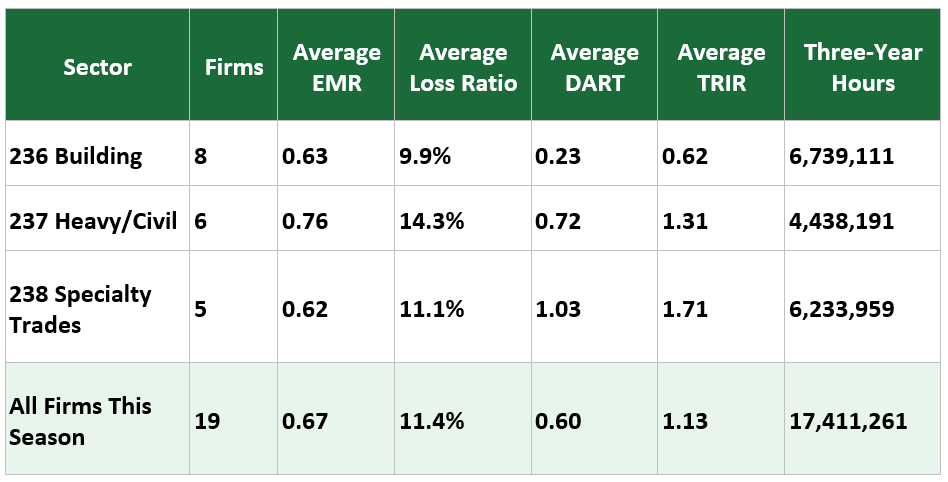
This year, the 19 successful applicants for PRIDE demonstrated exceptional statistical performance, as seen in the table below (averages in the total row are weighted equally by firm, not by hours worked):
To frame these statistics, the chart below compares this season’s firm-average DART (days away, restricted, or transferred) and TRIR (total recordable incident rate) with last year’s PRIDE class and with 2024 construction averages for Oregon and the United States (NAICS 23).
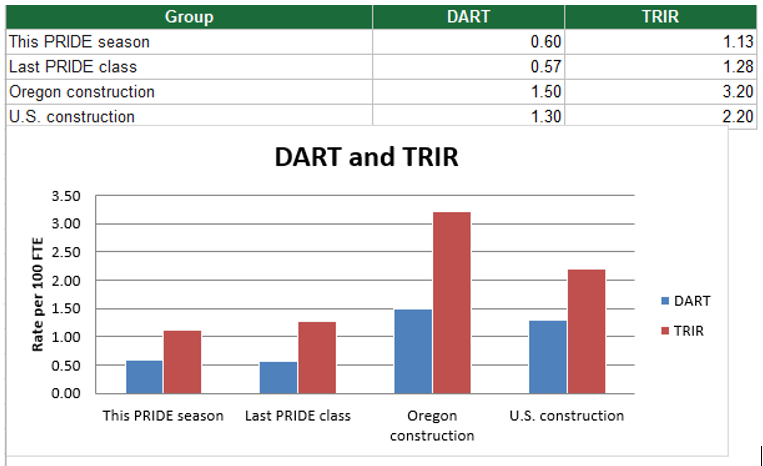
Compared with Oregon’s 2024 construction averages, the current PRIDE cohort’s average DART of 0.60 and TRIR of 1.13 are about 60% lower and 65% lower, respectively. Compared with 2024 U.S. construction averages, the same rates are about 54% and 49% lower, respectively.
These AGC members already had to meet or beat Oregon averages to enter PRIDE; the figures above show how far the cohort sits below statewide and national construction benchmarks. In practical terms, AGC PRIDE companies are among the safer construction employers to work for in Oregon, and they compare favorably with typical U.S. construction performance.
This means AGC PRIDE companies are among the safest construction companies to work for, not only in Oregon but nationwide. How do they achieve this? There are many reasons, but we’ve found across the board the following strengths:
- Management commitment to safety. Examples of this commitment this year include giving all employees stop-work authority, maintaining an “open” safety budget, committing to training foremen and superintendents through OSHA 30 and OSHA 510 courses, requiring extensive documented safety planning for all projects, and more.
- Employee involvement with safety. This included craft workers’ participation on safety committees, increasing access to safety-issue reporting through QR codes, and soliciting craft workers’ feedback on safety decisions.
- Hazard identification and control. The AGC team frequently saw documented site safety audits tracked by senior leadership. Items identified for correction were given a timeline for closeout, and solutions were not only implemented but also shared across job sites and with other trades to raise awareness of relevant safety issues.
- Use of technology. We saw augmented reality systems for identifying the placement of underground utilities, presence-detecting AI cameras on mobile equipment, drones used to map job sites, and telematics systems on fleet vehicles that track all driver activity and use AI to alert management when risky conditions are detected.
These are just some of the practices we saw among AGC PRIDE applicants this year that reduced injury rates and reinforced safety culture within their companies. We look forward to formally recognizing all these employers with the PRIDE award at the annual business meeting on January 29, 2027.
If you are interested in pursuing PRIDE next year, the season will start on March 1, 2027. An informational webinar is tentatively scheduled for March 9, 2027, at 9 am, during which we will review the application process and program.